
What Are the Impacts of Automation on the Job Market?
A friend of mine worked in a bank for eleven years.
She was good at her job — genuinely good. She knew her customers by name, remembered details about their lives, and could walk someone through a complicated financial decision with a patience and clarity that no machine has ever replicated. She was, by every measure that mattered to the people she served, irreplaceable.
Then the branch started installing more ATMs, then self-service kiosks, then a mobile app that handled ninety percent of what customers used to come in for. The foot traffic slowed. Then the branch reduced its hours. Then it reduced its staff. Then one Thursday morning she came in to find a letter on her desk that began with the words “due to operational restructuring.”
She was not fired because she was bad at her job. She was displaced because the economics of her job changed around her while she was doing it well. That distinction matters — and it is one that tends to get lost in the abstract, data-heavy conversations we have about automation and employment.
This is not an abstract issue. It is happening to real people, in real workplaces, right now — and it is going to accelerate. Understanding what automation is actually doing to the job market — not in theory but in practice, not just the threats but the genuine opportunities — is one of the more important things a working person can do in 2026.
So let us have that conversation properly.
What We Actually Mean When We Say Automation
The word automation gets used so broadly these days that it has started to lose its meaning. When people say automation, they might mean a robotic arm on a car assembly line, a chatbot handling customer service queries, a machine learning algorithm screening job applications, a self-checkout kiosk at a supermarket, or a piece of software that generates financial reports in seconds that once took a team of analysts hours to produce.
These are very different technologies with very different implications — but they share a common thread. They all involve the transfer of tasks that were previously performed by human workers to systems that can perform those tasks without ongoing human input.
What makes the current era of automation different from previous waves of mechanisation — the industrial revolution, the introduction of assembly lines, the computerisation of the 1980s and 90s — is its breadth. Previous waves of automation primarily targeted physical, repetitive, manual tasks. The current wave, driven by artificial intelligence and machine learning, is beginning to encroach on cognitive tasks that were previously considered safe from automation: analysis, writing, customer interaction, legal research, medical diagnosis, financial planning.
For the first time in history, automation is not just threatening blue-collar workers. It is sitting across the table from white-collar professionals and asking the same uncomfortable question: what, exactly, can you do that I cannot?
The Real Benefits of Automation — And Why They Matter
Before getting into the harder parts of this conversation, I want to spend real time on the genuine benefits of automation, because I think the debate tends to polarise quickly into either uncritical enthusiasm or reflexive alarm, and neither serves the goal of actually understanding what is happening.
Productivity and Efficiency That Changes What Is Possible
Automation genuinely does things that human workers cannot. Not better versions of what humans do — fundamentally different things. An automated system can process thousands of insurance claims simultaneously. A machine learning algorithm can analyse medical images at a scale and speed that no radiologist could match. A robotic assembly system can maintain precision tolerances across millions of repetitions without fatigue, distraction, or variation.
The productivity gains from automation are not trivial. They represent a genuine expansion of what economies can produce — and that expansion, when distributed reasonably, translates into lower costs for consumers, higher output for businesses, and the freeing of human capacity for work that requires specifically human qualities.
Taking Humans Out of Dangerous Situations
One of the least discussed but most meaningful benefits of automation is its role in workplace safety. Mining robots operating in unstable shafts. Automated systems handling toxic chemical processes. Drones conducting infrastructure inspections that would otherwise require workers in dangerous elevated positions. Bomb disposal robots. The automation of genuinely dangerous work is not a threat to human welfare — it is an expression of it.
In sectors where occupational injury and death rates have historically been high, automation has produced real and measurable reductions in harm. This deserves to be acknowledged clearly rather than buried under economic anxiety about job numbers.
The Liberation of Human Capacity for Better Work
There is a version of the automation story that is genuinely optimistic and genuinely supported by evidence — the version in which automating routine, repetitive, cognitively undemanding tasks liberates human workers to focus on the work that is more creative, more interpersonal, more strategic, and more genuinely fulfilling.
The evidence for this exists. Companies that have implemented automation thoughtfully report that employees who are relieved of repetitive data entry, routine processing, and mechanical tasks report higher job satisfaction and greater engagement with the work that remains. The work that tends to survive automation well — work requiring empathy, creativity, complex judgment, relational intelligence, and ethical reasoning — also tends to be the work that people find most meaningful.
This is the version of the automation story worth working toward. It is not inevitable. It requires deliberate choices about how productivity gains from automation are distributed and how workers whose roles change are supported through that change. But it is genuinely possible.
Quality and Consistency at Scale
In manufacturing, healthcare, and food production — in any field where consistency and precision matter and where human error has real consequences — automation has produced improvements in quality that represent genuine human benefit. Pharmaceutical manufacturing with automated quality control. Surgical robots that allow for precision at scales the human hand cannot achieve. Aviation autopilot systems that have made air travel dramatically safer. These are not abstract business efficiencies. They are things that improve and save lives.
The Genuine Challenges — Honest and Unvarnished
Now for the harder part. And I want to be direct here, because I think a lot of writing on this topic soft-pedals the challenges in ways that do not serve the people most affected by them.
Job Displacement Is Real and It Is Not Evenly Distributed
Let us start with the most fundamental challenge, because everything else flows from it.
Automation displaces workers. This is not a theoretical risk or a future concern — it is a present reality that is already well-documented across multiple industries. The question is not whether job displacement from automation is happening. It is how significant it is, how permanent it is, and who bears the cost of it.
The historical counterargument to displacement concerns — the one that economists have deployed through every previous wave of automation — is that technology creates as many jobs as it destroys, and usually more. The agricultural revolution displaced farm workers and created industrial workers. The industrial revolution displaced factory workers and created service workers. The computerisation of offices displaced data entry clerks and created software engineers, systems administrators, and a vast ecosystem of technology-dependent roles.
This argument has merit as a historical description. Whether it holds with the same confidence for the current wave of AI-driven automation is genuinely uncertain — and that uncertainty should be taken seriously rather than dismissed.
The jobs created by previous waves of automation were, in significant part, accessible to workers displaced by that automation with reasonable retraining. The transition from agricultural labour to factory work was difficult and socially disruptive, but the basic skill requirements were broadly accessible.
The jobs being created by AI-driven automation — AI development, machine learning engineering, data science, complex systems management — require levels of technical education and cognitive skill that are not accessible to most workers displaced by automation in the current wave. The transition is not just economically difficult. In many cases, it is genuinely impossible for the workers most affected without support structures that do not currently exist at adequate scale.
My friend from the bank was fifty-one when she received that letter. She had eleven years of relationship banking experience and exceptional interpersonal skills. She did not have a computer science degree and she was not in a position to go and get one. The jobs being created by the digitalisation of banking were not available to her. That is not a personal failure. It is a structural problem.
The Skills Mismatch That Nobody Is Solving Fast Enough
Closely related to displacement is the growing gap between the skills that workers currently possess and the skills that the automated economy increasingly demands. This is sometimes described as if it is primarily a problem of workers needing to try harder or be more adaptable. I think that framing is both inaccurate and unfair.
The pace at which automation is transforming job requirements is faster than the pace at which educational and training institutions are adapting to those changes. The average worker changing careers today navigates a retraining landscape that is fragmented, expensive, geographically inconsistent, and frequently disconnected from actual employer needs. The gap between the skills the economy needs and the skills being developed by workers navigating this landscape is not closing fast enough. It is, in many regions and sectors, widening.
This is not primarily a problem of individual effort. It is a problem of institutional design — of education systems, training programs, government policy, and employer investment in workforce development that has not kept pace with the rate of technological change. Naming that clearly matters, because misidentifying the problem leads to misidentifying the solutions.
Income Inequality and Job Polarisation
One of the most consistently documented economic effects of automation over the past several decades is what labour economists call job polarisation — the hollowing out of middle-skill, middle-wage occupations in favour of growth at the high end and the low end of the labour market.
The pattern is relatively consistent across developed economies. Automation and AI are particularly effective at replacing routine tasks — whether those tasks are physical or cognitive — that sit in the middle of the skill and wage distribution. Assembly line work, data processing, bookkeeping, routine legal and financial analysis, administrative coordination. These are the roles that have been most exposed to automation over the past two decades, and their share of employment has declined significantly.
What remains — and what tends to grow — is work at both extremes. High-skill, high-wage work requiring expertise, creativity, and complex judgment that automation cannot replicate. And low-skill, low-wage service work — care work, cleaning, food service, personal services — that automation has so far found difficult to replace, partly because the tasks require physical adaptability and social intelligence, and partly because the economics of automating low-wage work are less compelling to businesses.
The workers displaced from the middle find it very difficult to move up to the high end without significant education and retraining. They find it economically devastating to move down to the low end. Many fall out of employment entirely, at least temporarily. And the cumulative effect of this polarisation on income inequality — on the distribution of the gains from productivity growth — is one of the defining economic and social challenges of the current era.
The Geographic Dimension That Gets Ignored
Here is something that rarely makes it into mainstream coverage of automation’s impact on employment: the effects are profoundly uneven geographically, and that unevenness has consequences that extend well beyond economics.
Automation does not affect all regions equally. It tends to hit hardest in communities where employment is concentrated in a small number of industries — manufacturing towns, mining communities, regions where a single sector dominates the local economy. When automation displaces significant employment in those settings, the effects are not just economic. The social fabric of entire communities is affected. Local businesses lose customers. Tax bases shrink. Infrastructure deteriorates. Social problems associated with economic dislocation — substance abuse, family breakdown, political disillusionment — increase.
These communities cannot simply relocate to where the new jobs are being created, because communities are not just economic units. They are networks of relationships, family ties, cultural identities, and shared histories that people are understandably reluctant to abandon. The human cost of the geographic concentration of automation’s disruption is enormous and is regularly underweighted in economic analyses that look only at aggregate employment numbers.
What Is Actually Happening in Specific Industries
Let me ground this in some specific sector-level examples, because the abstract discussion benefits from concrete illustration.
Manufacturing: The Textbook Case
Manufacturing is where the automation story has been playing out the longest and most visibly, and the picture is more complicated than it is usually presented.
Total manufacturing output in most developed economies has increased significantly over the past three decades. Total manufacturing employment has declined significantly over the same period. These facts coexist because automation has dramatically increased productivity per worker — meaning that substantially more can be produced with substantially fewer people.
The jobs that have disappeared from manufacturing are not trivial ones. They were often unionised, well-compensated, stable positions that provided solid middle-class livelihoods without requiring advanced degrees. The communities built around those jobs — in the American Rust Belt, in post-industrial Britain, in parts of Germany and Japan — have in many cases not recovered the employment quality that was lost. The new manufacturing jobs tend to require higher technical skills and are fewer in number relative to the output they support.
Retail: The Visible Transformation
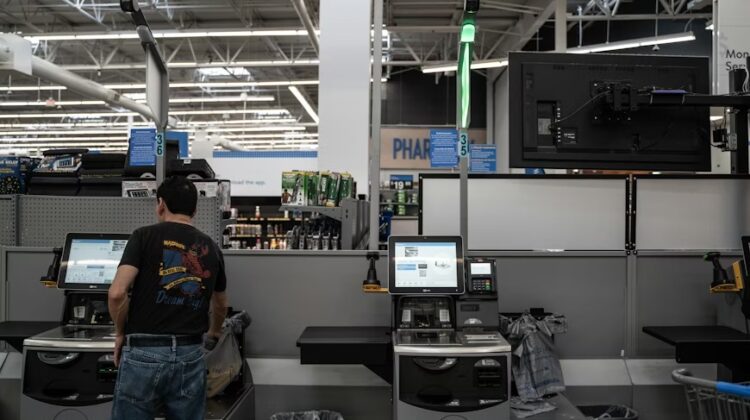
Anyone who has been in a supermarket recently has watched automation reshape retail employment in real time. Self-checkout machines have become standard. Inventory management has been automated. Customer service chatbots handle routine enquiries. Cashier and checkout roles — which represent millions of jobs globally — are being steadily reduced.
Amazon’s fulfilment centres represent perhaps the most striking example of the dual nature of retail automation. They employ large numbers of people in physically demanding warehouse roles. They also employ sophisticated robotic systems alongside those people — and the trajectory of the ratio between human workers and robotic systems in those facilities is unambiguous. The automation is advancing and the human headcount per unit of output is declining.
The retail jobs most at risk are those involving routine transaction processing and inventory management. The retail roles that are proving more resilient are those requiring human judgment, product expertise, and personalised customer interaction — though even those are under increasing pressure.
Professional Services: The Unexpected Frontier
This is where the current wave of automation is diverging most sharply from historical patterns — and where the implications for white-collar professionals are most significant and most underappreciated.
AI systems are now performing legal research that previously occupied junior lawyers. Automated systems are processing routine accounting tasks. Medical AI is reading diagnostic imaging with accuracy comparable to specialist radiologists in specific applications. Financial analysis that required teams of analysts can now be produced in minutes by automated systems. Journalism, copywriting, and basic content creation are being partially automated at scale.
These are not low-skill occupations. These are professions that required years of education, commanded significant salaries, and were broadly assumed to be safe from automation. The fact that they are now facing meaningful automation pressure is reshaping career planning and educational investment in ways that are still very much in progress.
What Individuals Can Actually Do
I do not want to end this article in the place of pure structural analysis without addressing the practical question that most people reading it actually care about: what do I do about this?
Develop skills that are genuinely hard to automate. This means, broadly, skills that require the specifically human qualities that machines currently handle poorly: empathy and emotional intelligence, creative and original thinking, complex ethical judgment, the ability to build genuine trust and relationships, the capacity to navigate ambiguity and uncertainty with wisdom rather than just processing power. These qualities are not automation-proof forever — but they are the most durable bet available, and they are worth cultivating deliberately.
Stay technically literate even if you are not a technical specialist. You do not need to be a software engineer to work effectively in an automated economy. But you do need to understand, at a functional level, how the automated systems in your field work, what they are capable of, and where they fall short. The workers who will fare best in the automated economy are not the ones who compete with automated systems at what those systems do best — it is those who can use those systems effectively, supervise them intelligently, and identify the things they cannot do.
Treat learning as ongoing rather than front-loaded. The model in which you complete your education in your twenties and apply it for the following forty years is no longer viable for most professions. The pace of change in almost every field now requires ongoing learning — not occasional updating, but genuine continuous development of skills and knowledge. Building that habit early and maintaining it throughout a career is one of the most important protective measures available.
Pay attention to the political and policy conversation. The individual responses matter. But the structural challenges of automation — displacement without adequate support, the uneven geographic distribution of disruption, the growing gap in income inequality — are not solvable at the individual level alone. They require policy responses: investment in retraining infrastructure, rethinking of social safety nets, serious conversation about how the productivity gains from automation are distributed across society. Engaging with that conversation, at the ballot box and in public discourse, is part of the response to automation that individuals can meaningfully contribute to.
The Question Nobody Wants to Answer Directly
Here is the question that sits underneath everything else in this conversation, and that tends to get avoided because there is no clean, comfortable answer to it.
When automation generates enormous productivity gains — when companies produce significantly more with significantly fewer workers — who benefits from that increase in value?
Historically, the answer has been: primarily the owners of the automated systems and the highly skilled workers who design, manage, and complement them. The workers displaced by automation have tended to bear the costs while the gains have flowed elsewhere. That is not a law of nature. It is a consequence of specific policy choices — about taxation, about labour regulation, about investment in public goods — that different societies have made differently with different outcomes.
The countries that have navigated previous waves of automation with the least social damage are generally those that invested heavily in retraining and transition support, maintained strong social safety nets that cushioned displacement without penalising workers for it, and found mechanisms to ensure that productivity gains were distributed broadly rather than concentrated narrowly.
Those choices are available to societies navigating the current wave too. Whether they will be made is a political question as much as an economic one. And the answer will shape the experience of automation for working people far more than any individual career strategy.
Conclusion
Automation is not coming. It is here. It is reshaping employment in manufacturing, retail, professional services, and healthcare right now — not in ways that are uniform or simple, but in ways that are real and accelerating.
The honest assessment is that this creates both genuine opportunity and genuine hardship — and that which of those dominates for any particular person, community, or society depends heavily on choices that are still being made. Choices about investment in education and retraining. Choices about how productivity gains are distributed. Choices about the kind of safety nets that exist for workers navigating displacement. Choices about whether the efficiency gains of automation translate into broader human flourishing or narrower economic concentration.
My friend from the bank eventually found her footing. It took two years, a retraining program, and a significant income adjustment in the interim — but she found a role in a small financial advisory firm where her relational skills and deep knowledge of her clients’ financial lives turned out to be exactly what the business needed. Her story has a reasonable ending.
Not everyone’s does. And making sure more of them do is the central challenge of the automated economy — one that belongs to all of us, not just to the people whose letters start with “due to operational restructuring.”
This piece took a while to think through. If it raised questions or perspectives you want to discuss, drop them in the comments — I read everything. And explore more work and economy content right here on DennisMaria.
This article is written for general informational and educational purposes. Economic projections and labour market trends involve significant uncertainty and vary considerably by region, sector, and individual circumstance. Nothing here constitutes career or financial advice.