
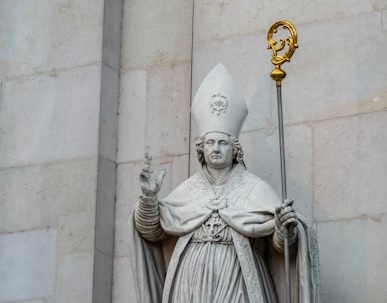
Pope Innocent III in Purgatory: The Shocking Vision of St. Lutgarda That Shook the Church
Throughout Christian history, accounts of souls appearing from Purgatory have served as some of the most sobering reminders that God’s justice is perfectly impartial. No title, no rank, no earthly power can buy a shortcut past divine judgment.

One of the most remarkable and well-documented of such accounts involves Pope Innocent III — widely regarded as one of the most powerful and influential pontiffs in the entire history of the Catholic Church — appearing to a humble Belgian mystic named St. Lutgarda of Aywieres, on the very day of his death.
This story is not just a curiosity from medieval history. It carries a profound spiritual message that is as relevant today as it was in the 13th century.
Who Was Pope Innocent III?
Pope Innocent III (born Lotario dei Conti di Segni) served as the Supreme Pontiff of the Roman Catholic Church from 1198 to 1216 A.D. He is widely considered one of the most powerful popes ever to occupy the Chair of St. Peter.
Among his most notable achievements was presiding over the Fourth Lateran Council of 1215 A.D. — one of the most significant Church councils in history, which addressed issues ranging from Church doctrine to the Crusades and the reform of Christian morality.
In short, Innocent III was no ordinary man. He was a towering figure of ecclesiastical power and spiritual authority. Which makes the story of his appearance to St. Lutgarda all the more astonishing.
Who Was St. Lutgarda of Aywieres?
St. Lutgarda (1182–1246) was a Flemish mystic and Cistercian nun renowned for her extraordinary spiritual gifts, including visions, bilocation, and miraculous healings. She spent most of her religious life at the monastery of Aywieres in Brabant (modern-day Belgium).
Her holiness was so well-known that she was frequently sought out by souls in Purgatory seeking the intercessory prayers of a living saint. Her biography was written by the noted Dominican friar Thomas de Cantimpré, who carefully documented the apparitions she received.
The Apparition: Pope Innocent III Appears in Flames
On July 16, 1216 — the very day Pope Innocent III drew his last breath in Perugia, Italy — something extraordinary happened hundreds of miles away at the monastery of Aywieres in Brabant.
St. Lutgarda suddenly beheld a terrifying vision: a figure completely engulfed in flames, crying out to her.
Startled but composed, Lutgarda asked: “Who are you, and what do you want?”
The response shook her to the core.
“I am Pope Innocent,” the apparition replied.
Barely able to believe what she was hearing, Lutgarda responded in shock: “Is it possible that you, our common Father, should be in such a state?”
The Pope’s Own Words: Three Faults, Centuries of Suffering
What followed was a confession that no amount of earthly power could have prevented.
The Pope’s soul explained that he was expiating three serious faults — sins that, by God’s mercy and the intercession of the Blessed Virgin Mary, had not condemned him to hell but still demanded purgatorial atonement.
His words were haunting:
“It is but too true. I am expiating three faults which might have caused my eternal perdition. Thanks to the Blessed Virgin Mary, I have obtained pardon for them, but I have to make atonement. Alas! it is terrible; and it will last centuries if you do not come to my assistance. In the name of Mary, who has obtained for me the favour of appealing to you, help me.”
With that, the apparition vanished.
The Miraculous Confirmation: News That Hadn’t Arrived Yet
Here is where the account becomes even more remarkable.
At the time of this apparition, news of the Pope’s death had not yet reached the monastery in Brabant. Communication in the 13th century was slow — it could take days or even weeks for major news to travel across Europe.
When St. Lutgarda immediately told her fellow sisters that Pope Innocent III had just died, they were baffled. How could she possibly know this?
It was only approximately two weeks later that official news finally reached the monastery, confirming the Pope’s death on the exact date — July 16, 1216 — the very day of the apparition.
This precise confirmation served as powerful evidence that the vision was genuine and not the product of imagination.
What Were the Three Faults?
Thomas de Cantimpré, who wrote the biography of the Pope after receiving this account from St. Lutgarda, deliberately omitted the three specific faults out of deep respect for so great a pontiff. Other writers and historians who have retold this story have similarly chosen not to reveal them.
This discretion is itself a lesson in Christian charity — it is not our place to catalogue the sins of the repentant dead.
What matters far more than the specifics is the universal truth this apparition teaches.
The Core Lesson: God Shows No Favouritism
Perhaps the single greatest takeaway from this episode is stated plainly in the Book of Wisdom:
“A more severe judgment shall be for them that bear rule.” — Wisdom 6:6
Pope Innocent III was, by any earthly measure, one of the most powerful and accomplished religious leaders in human history. And yet, he appeared in flames, begging for the prayers of a humble nun.
This account powerfully illustrates three timeless truths:
1. God makes no exceptions of persons. Rank, title, and religious office offer no immunity from divine justice. The same God who judges the poorest sinner judges the most powerful pope.
2. Greater responsibility means greater accountability. To those given much authority, much will be required. Leaders — whether spiritual, political, or social — bear a heavier burden of accountability before God precisely because of the influence they wielded over others.
3. The prayers of the living genuinely help the dead. The Pope specifically appealed to St. Lutgarda’s intercessory prayers, begging her assistance. This aligns with the Catholic teaching rooted in Scripture (2 Maccabees 12:45–46) that prayers and good works offered by the living can reduce the suffering of souls in Purgatory.
The Power of Marian Intercession
It is also deeply significant that the Pope credited the Blessed Virgin Mary with obtaining for him the grace to appear to St. Lutgarda and seek her prayers. Without this divine permission, no soul can cross from the beyond to communicate with the living.
This adds yet another dimension to the story: even in Purgatory, devotion to Mary and her intercession continues to bear fruit.
What This Means for Us Today
The apparition of Pope Innocent III to St. Lutgarda is far more than a fascinating medieval tale. It is a mirror held up to every soul — from the most obscure layperson to the highest Church official — reminding us of several sobering realities:
- No sin goes unaddressed — if not atoned for here, then purged hereafter.
- Confession and repentance are vital, but the temporal consequences of sin often remain even after forgiveness.
- Praying for the dead is not a pious tradition — it is an act of mercy that can literally shorten the suffering of souls.
- Mary’s intercession is powerful — even Popes in Purgatory rely upon it.
If a man of such ecclesiastical greatness could find himself in such a state, what should that tell each of us about the seriousness with which we must approach our own spiritual lives?
Conclusion: A Call to Humility, Prayer, and Atonement
The story of Pope Innocent III’s appearance to St. Lutgarda stands as one of the most compelling accounts in the rich tradition of Catholic mysticism. It is at once deeply humbling and deeply encouraging.
Humbling — because it reminds us that no earthly greatness exempts us from answering to God.
Encouraging — because it shows us that God’s mercy is available to all who seek it, even those who sinned greatly. And it reminds us that our prayers for the dead are not wasted — they are heard, they matter, and they bring relief to souls who can no longer help themselves.
Let this account move us to pray more earnestly for the souls in Purgatory — our family members, friends, and even great leaders of history who may still be awaiting the fullness of God’s mercy.
“It is a holy and wholesome thought to pray for the dead, that they may be loosed from sins.” — 2 Maccabees 12:46
Share this article if it moved or inspired you. And don’t forget to pray for the souls of the faithful departed today.