
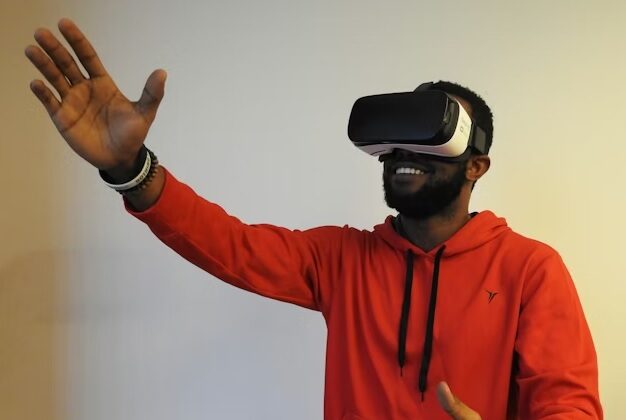
Virtual Reality Sounds Amazing Until You Actually Think About It
I remember the first time I tried a VR headset. A friend brought one over, strapped it onto my face, and suddenly I was standing on the edge of a virtual skyscraper looking down at a city hundreds of floors below.
My legs genuinely buckled.
My brain knew — completely, logically knew — that I was standing in a living room with carpet under my feet. And yet every instinct in my body was screaming that I was about to fall to my death. I grabbed the nearest wall and my friend nearly fell over laughing.
That moment stuck with me. Not because it was fun, although it was. But because it made me realize something that I think a lot of people gloss over when they talk about virtual reality: this technology does not just entertain your brain. It genuinely fools it. And anything powerful enough to do that deserves a lot more serious thought than most of us are giving it.
The Part Everyone Agrees On
Look, the upside of VR is not hard to sell. The technology is legitimately impressive and the applications go way beyond gaming.
Surgeons are training in virtual operating rooms before they ever touch a real patient. Therapists are using VR environments to help people with phobias and PTSD confront their fears in controlled, safe settings. Kids are taking virtual field trips to ancient Rome and the bottom of the ocean. Architects are walking clients through buildings that have not been built yet.
These are not gimmicks. This is genuinely useful technology changing how people learn, heal, and work — and we are still very much in the early days. The potential here is enormous and I do not want to be dismissive of that.
But.
Here Is What Actually Worries Me
There is a tendency when a new technology comes along — especially one as flashy and exciting as VR — to let the enthusiasm drown out the legitimate concerns. We did it with social media. We did it with smartphones. We collectively decided these things were mostly fine and figured we would deal with the problems as they showed up.
We are still dealing with them.
I would rather not make the same mistake twice with virtual reality.
The Addiction Question Nobody Wants to Have
Let me be blunt about something. VR is being designed by some of the most sophisticated teams in the world with one primary commercial goal: to keep you inside the headset as long as possible. The same engagement-maximizing logic that turned social media into a slot machine in your pocket is now being applied to an experience that is infinitely more immersive.
Think about that for a second.
Researchers at UC Davis found that regular VR users were displaying behavior that looked a lot like addiction — prioritizing headset time over real-world activities, feeling irritable and anxious when access was taken away, spending more time in the virtual world than they intended or wanted to. And this was with the relatively primitive VR that existed a few years ago.
As the technology gets better — and it is getting better incredibly fast — virtual environments are going to become more beautiful, more social, more responsive, and more rewarding than many parts of ordinary life. When that happens, the pull toward staying in them is going to be something we genuinely have not had to deal with before as a society.
I am not saying everyone who owns a VR headset is going to become addicted to it. I am saying we should probably talk about this more than we are.
It Can Mess With Your Head in Ways That Are Hard to Predict
Stanford researchers looked at VR and mental health and found something that should give us pause. For some people — particularly those dealing with anxiety disorders, phobias, and trauma — VR-based therapy was genuinely helpful. Controlled exposure to frightening scenarios in a safe environment helped them work through their fears.
For others, the exact same kind of exposure made things worse.
The problem is that VR does not know which category you fall into. A horror VR game does not ask whether you have PTSD before it puts a monster six inches from your face. A highly immersive violent scenario does not check whether the teenager wearing the headset has a history of anxiety. The technology is neutral — it just delivers the experience. The consequences are yours to deal with afterward.
For most people most of the time this is probably fine. But “probably fine for most people” is not the same as “safe” and we should not pretend otherwise.
The Physical Stuff Is Real Too
I want to talk about something that VR marketing materials tend to mention briefly and quietly before moving on: a lot of people feel genuinely awful after using VR.
Nausea, dizziness, headaches, eye strain, disorientation — these are not rare edge cases. They are common enough that the industry has its own term for it: cybersickness. It happens because your visual system is telling your brain you are moving while your body is standing completely still, and your brain does not know what to do with that contradiction.
For some people the symptoms are mild and pass quickly. For others they are bad enough that VR is essentially unusable. And for regular users the repeated eye strain from staring at screens millimeters from your face raises questions about long-term vision health that honestly we do not have great answers to yet — because the technology is too new to have generated the longitudinal research that would tell us.
If you have kids, this is especially worth paying attention to. Most VR manufacturers quietly recommend against use by children under twelve or thirteen. That recommendation exists for a reason. Kids’ eyes and brains are still developing and we genuinely do not know what regular VR exposure does to that development over time. That uncertainty alone should make parents cautious.
Your VR Headset Knows an Uncomfortable Amount About You
This one gets buried in the excitement but I think it is actually one of the most important issues in the whole VR conversation.
Your VR headset is tracking your eye movements. It knows where you look, what catches your attention, how long you stare at something before looking away. It tracks your body language and your physical movements. It builds up a remarkably detailed behavioral profile of you — one that is arguably more intimate than anything your phone knows about you, because it is capturing how your body responds to things, not just what you choose to type or click.
The Electronic Frontier Foundation put out research on exactly this issue and it is genuinely alarming reading. The amount of biometric data that VR devices are capable of collecting is extraordinary, and the protections governing what companies can do with that data have not remotely kept pace with the technology.
Think about what that data could be used for. Targeted advertising that responds to your actual physical reactions to things. Insurance companies that can assess your stress responses and decision-making patterns. Governments interested in biometric surveillance at scale. The technology to collect all of this already exists. The ethical and legal frameworks to govern it do not.
A Quick Word About Social Isolation
I want to bring this up because I think it gets underestimated.
There are VR platforms now designed specifically to be social — places where you can hang out with friends as avatars, attend virtual events, meet new people. And I understand the appeal, especially for people who are isolated by geography or circumstance.
But I keep coming back to this: the more satisfying and convenient virtual social interaction becomes, the less motivated some people are going to be to do the harder work of maintaining real-world relationships. And real-world relationships — the messy, inconvenient, physically present kind — are genuinely irreplaceable for human wellbeing. We have good research on this. Loneliness kills people. Social isolation is as harmful to long-term health as smoking.
VR is not going to solve loneliness. For vulnerable people, it might quietly make it worse while feeling like it is helping.
So What Do We Actually Do About This?
I am not here to tell you to throw your VR headset in the bin. That is not a realistic or useful conclusion.
What I do think is useful is going into VR — whether as an individual user, a parent, or just someone who pays attention to where technology is headed — with your eyes open rather than closed.
A few things that genuinely seem worth doing:
Set a timer before you put the headset on. Decide in advance how long the session is going to be and stick to it. The immersive nature of VR makes it genuinely hard to self-regulate from inside the experience — so make the decision before you start rather than trying to make it when you are already absorbed.
Take children’s age limits seriously. Not as a suggestion. As a real limit. The manufacturers are not putting those age recommendations in the manual because they are overcautious. They are there because there are real developmental concerns.
Check your privacy settings and actually read them. I know. Nobody reads privacy settings. But with VR especially it is worth at least understanding what your device is collecting and what the company’s policy is on using it.
Notice how you feel when you take the headset off. Not just immediately — but an hour later, a day later. Do you feel energized and like the experience was a good use of time? Or do you feel vaguely disconnected, less interested in ordinary life, already thinking about when you can get back in? Your honest answer to that question matters.
Do not let it replace real-world social time. Use it as an addition to your actual social life, not a substitute for it. They are not the same thing, even when VR social platforms are very good.
Where This Is All Going
Here is the thing I keep coming back to whenever I think about VR’s trajectory.
The technology is going to keep improving. The experiences are going to become more realistic, more social, more emotionally engaging, and more indistinguishable from physical reality. The commercial incentives pushing that development are enormous and they are not going away.
What determines whether this ends well or badly is not the technology itself. It is whether we — as individuals, as parents, as a society — develop the awareness and the framework to use it wisely before we are so deep into it that course-correcting becomes very difficult.
We have been slow to learn this lesson with other technologies. We let social media reshape childhood, political discourse, and mental health before we really understood what it was doing. We are still untangling that.
Virtual reality deserves a more clear-eyed approach from the start. Not fear — but honesty. Not a ban — but real, enforced boundaries. Not panic — but the kind of thoughtful attention that we give to other powerful things that have the potential to genuinely change how human beings experience reality.
Because that is exactly what VR is. Something that changes how human beings experience reality.
That is worth taking seriously.
If this made you think differently about VR — or if you strongly disagree with something I said — drop it in the comments. I read all of them and I am genuinely curious what others think about where this technology is heading.
Just to be clear: nothing in this article is medical or psychological advice. If VR use is affecting your health or someone you know, talk to an actual doctor — not a blog.