
The Ancient Yoruba Boy Who Owed the Morning
In the age when Ifa still walked among men in the body of an old man who smelled of palm oil and bitter kola, there was a town called Ìpàdé — the Place of Meeting — that sat at the crossroads of three ancient roads in the country that would one day be called Yorubaland.

Every road that mattered passed through Ìpàdé. The road from the coast carrying salt and foreign cloth. The road from the north carrying leather and dried meat and the occasional scholar who had walked so far from home that he had forgotten what home looked like. The road from the forest carrying the things the forest gives when it is in a generous mood — herbs, honey, silence, and sometimes something else entirely, something that arrives without a name and leaves without permission.
The people of Ìpàdé said: every destiny passes through a crossroads at least once. They said it the way people say things that are both true and dangerous — quietly, and only to those who were ready to hear it.
This is the story of a boy who arrived at his crossroads before he was ready.
His name was Àyọ̀délé.
I. The Naming
He was born feet-first on the night of a lunar eclipse, which the babalawo who attended his birth noted with the careful stillness of a man writing something significant in a place where it would not be lost.
His father, a prosperous cloth merchant named Adébísí, had wanted to name him something simpler — a name that meant abundance, or blessing, or success in trade. Something forward-facing. Something that looked at the future with appetite.
But the babalawo, whose name was Fásọlá and who had been reading Ifa for forty years with the accumulated patience of someone who had long ago made peace with what the oracle said versus what people wanted to hear, cast the divination three times. Three times the same pattern emerged from the palm nuts on the divining tray. Three times the same verse rose from the deep well of Ifa’s memory.
He looked at Adébísí with the expression he reserved for news that required careful framing.
“This child,” Fásọlá said, “came into the world carrying something.”
Adébísí straightened. “Carrying what?”
“A debt.” Fásọlá touched the divining tray gently, the way you touch something sacred that you want to make sure is still there. “Not his own. Something older. Something that was left unfinished before he arrived.”
“By whom?”
Fásọlá was quiet for a moment. “By a woman who loved Ọ̀ṣun so completely that she promised her firstborn son to the river’s service. And then she died before she could honour it. And the promise did not die with her.”
Adébísí looked at his wife, who was holding the child and listening with the particular alertness of a woman who has just given birth and discovered that the world immediately has opinions about what she has produced.
“What does it mean,” she asked, her voice carrying the careful steadiness of someone managing a large feeling in a small space, “for my son?”
Fásọlá said: “It means he belongs to two worlds simultaneously. The world of men and the world of the river. It means his destiny has a shape that was drawn before he took his first breath. And it means—” he paused, “—that the choice he will be asked to make cannot be made for him. Not by his father. Not by me. Not by love. Only by him.”
He named the child Àyọ̀délé — joy has come home — because Fásọlá believed in naming children for what you needed them to carry into the world, not for what the world had already decided to ask of them. There would be time enough for the asking.
II. The Childhood of a Boy Between Worlds
Àyọ̀délé grew up knowing two things about himself that other children did not know about themselves.
The first was that water recognized him.
Not in the way that water recognizes all people — by accepting their weight, by parting for them, by doing the ordinary democratic things that water does for everyone. No. Water recognized Àyọ̀délé the way a person recognizes a relative they have not seen in a long time — with a particular attention, a leaning-toward. When he stood at the river’s edge, the current changed direction subtly, turning toward him the way a face turns toward a voice it knows. When it rained, the drops on his skin felt different than they felt on other skin — warmer, almost deliberate.
He told his mother about this when he was six. She listened with her eyes very still and then pulled him close and held him without explaining anything, which was its own kind of explanation.
The second thing he knew was that he dreamed in a language he did not speak while awake.
The dreams came on certain nights — not every night, but with enough regularity that he had learned to recognize the particular quality of the sleep that preceded them. A heaviness that was not fatigue. A loosening, as though the part of him that was anchored to the waking world was gently releasing its grip.
In the dreams he stood in a river that was also a road. The water flowed around his ankles but it did not wet him. Ahead of him, always at the same distance no matter how far he walked, was a woman in yellow and gold, her back to him, her hair adorned with brass and river stones. She never turned. She never spoke. But the air around her carried a sound — not quite music, not quite speech — that felt, when he woke from it, like something he had always known and perpetually forgotten.
He told Fásọlá about the dreams when he was nine. The old babalawo listened without surprise.
“That is Ọ̀ṣun showing you she remembers,” Fásọlá said simply.
“Remembers what?”
“That you belong to her conversation.” Fásọlá looked at him with eyes that had seen many things and were still, somehow, not tired of seeing. “Not to her. To her conversation. There is a difference, and when the time comes, that difference will matter more than anything I can teach you.”
Àyọ̀délé was nine years old and did not yet understand the difference. But he stored it the way children store the things adults say that are too large for them yet — carefully, in a place he could return to when he had grown enough to fit inside them.
III. What Ifa Said
On the morning of his sixteenth birthday, Fásọlá came to the compound before sunrise.
This was unusual enough that Àyọ̀délé’s mother woke her husband with the urgency of someone who already knew that unusual things arriving before sunrise rarely carry casual business.
Fásọlá sat in the compound and cast the divination with a formality he reserved for the most significant readings — washing his hands three times, invoking the sixteen principal Odù by name, placing the tray on the ground himself rather than having a student prepare it.
The pattern that emerged stopped his breath for just a moment. Then he composed himself, because forty years of reading Ifa had taught him that his composure was part of what he owed the people sitting before him.
“The time of choosing is coming,” he said. “Before the next dry season.”
Adébísí leaned forward. “Choosing what?”
“There is a sickness moving toward this town. It has been moving for three years and it will arrive before the harmattan. It comes from the east — a thing that the river has sent, not out of malice but out of imbalance. Something was taken from Ọ̀ṣun’s water long ago without the proper return being made.” He touched the tray. “She is calling for the account to be settled.”
“What is the account?”
Fásọlá looked at Àyọ̀délé. Not at Adébísí. At the boy.
“The account,” he said quietly, “is a life given to the river’s service. Freely. Without compulsion. That is the only currency Ọ̀ṣun accepts for this particular debt. A life offered by choice, in full knowledge of what is being offered, at the place where the three roads meet the water.”
The compound was absolutely silent.
Àyọ̀délé’s mother made a sound that was not a word.
“Service,” Adébísí said, his voice very controlled. “You said service. Not death.”
“I said what Ifa said.” Fásọlá met his eyes. “Service to the river is not death. But it is not the life you planned for him either. It is a crossing. What waits on the other side of that crossing — what the service becomes, what the boy becomes inside it — that I cannot see. Ifa shows the door. It does not show the room.”
IV. The Season of Dreaming
In the months that followed, Àyọ̀délé moved through his days with the strange doubled quality of someone living in two states simultaneously.
On the surface, his life continued. He helped his father in the cloth stall. He sat with his friends in the evenings and listened to them talk about girls and wrestling and the trader from Ìbàdàn who had passed through with goods none of them could afford. He ate his mother’s food and felt her watching him from across the table with eyes that were performing normalcy very carefully over something much more turbulent.
Underneath, he was listening.
He had decided, without fully articulating the decision, to listen to everything. To the town. To the water. To the quality of the air on different mornings. To the dreams, which had intensified — coming now every third night, vivid and layered, the woman in yellow and gold still ahead of him on the river-road, but closer now, always a little closer.
He listened to Fásọlá, who sat with him in the evenings and told him the deep stories of Ọ̀ṣun — not the festival stories that everyone knew, but the older ones, the ones that lived in the Odù verses and required permission to be told. Stories of her grief when her wisdom was excluded from the council of Orishas. Stories of how she had turned her pain into the sweetness of honey rather than the bitterness it could have become. Stories of what she loved: beauty, truth, the courage to feel things completely rather than managing them from a careful distance.
“She does not want suffering,” Fásọlá told him one evening. “People misunderstand this. They think sacrifice means pain. Ọ̀ṣun is not interested in your pain. She is interested in your truth. The sacrifice she asks is the sacrifice of the smaller life for the larger one. The sacrifice of the path you chose before you knew all the paths there were.”
Àyọ̀délé thought about this for a long time.
“What is my smaller life?” he asked.
Fásọlá smiled — a rare thing, and therefore a significant one. “Only you know that.”
V. The Crossroads
The sickness arrived with the first cold wind from the east, as Ifa had said it would.
It moved through the town quietly at first — a heaviness, a fatigue that was not resolved by sleep, a greying at the edges of things. The herbalists worked. The other babalawos read and prescribed. The remedies helped and then stopped helping. The sickness was patient in the way that ancient things are patient: it was not in a hurry because it did not need to be.
On the seventh day after the sickness arrived, Àyọ̀délé woke before dawn from the deepest dream he had ever had.
In this dream, the woman in yellow and gold had finally turned.
Her face was every face he had ever loved — his mother’s jaw, Fásọlá’s eyes, the expression his father wore when he thought no one was watching and allowed himself to be tired. It was not one face. It was the distillation of every face that had ever looked at him with something true in it.
She said: The debt is old but the choice is new. Every generation, the choice is new. I do not want what was promised. I want what is freely given. Do you understand the difference?
He said: I think so.
She said: Tell me.
He said: What was promised was made without me. What I give freely is mine to give. The first is an obligation. The second is a vow.
She was quiet for a moment that stretched in the dream-way, where a moment can hold everything.
Then she said: What do you freely give?
And Àyọ̀délé — sixteen years old, standing in a river that was also a road, in a dream that was also the truest waking of his life — said:
I give my ordinary life. I give the cloth stall and the evening conversations and the small plans I made without knowing there were larger ones. I give my unknowing. I am asking, instead, to know. To carry the knowledge of the water and bring it back to the land. Not to live in the river. To live between — the way a bridge lives between, belonging to both banks and owned by neither.
The air changed.
Ọ̀ṣun — for it was her, it had always been her — smiled with the fullness of someone who has been waiting a very long time for a very specific answer.
A bridge, she said, must be built with both hands. Go, child. Build.
VI. The Morning After
He woke to sunlight.
The town was breathing differently. The heaviness was not gone immediately — these things do not lift like cloth from a line, in one clean motion. But something had shifted in the quality of the air, the way air shifts in the hour before rain arrives, carrying the promise of what is coming.
He went to Fásọlá before eating.
The old babalawo looked at him for a long moment and then nodded, once, with the completeness of a man who has seen the answer to a question he has been holding for sixteen years.
“You dreamed,” Fásọlá said.
“She spoke.”
“What did she ask?”
“She asked what I would freely give.” Àyọ̀délé paused. “I told her I would give my ordinary life. I told her I would be a bridge.”
Fásọlá was quiet for the duration of three breaths. Then he said: “Do you know what that means? What it costs?”
“I know it means I will spend my life learning what the water knows and carrying it back to people who need it. I know it means I will not live the life my father lived, or the life I imagined before I knew there was something to imagine toward.” He looked at the old man. “I know it means I will sometimes be lonely in the way that bridges are lonely — belonging to both sides and claimed by neither.”
Fásọlá studied him with the particular quality of attention he gave to things that were completing themselves correctly.
“And you choose it.”
“I choose it.”
The babalawo reached into the folds of his agbada and withdrew something — a small brass ring strung on a cord of river grass, old in the way that objects are old when they have been handed from careful hand to careful hand across generations.
“This belonged to the woman who made the original promise,” Fásọlá said. “She gave it to me to give to the one who came after her. I have been carrying it for thirty years.”
He placed it in Àyọ̀délé’s palm. It was warm, in the manner of things that have been held close to a human body for a very long time.
“She loved Ọ̀ṣun truly,” Fásọlá said softly. “She would be glad it ended this way. In choice rather than compulsion. In understanding rather than obligation.”
Àyọ̀délé closed his fingers around the ring.
Outside, across the three roads, the river continued its ancient conversation with the land — patient, persistent, carrying everything downstream that needed to be carried, and keeping close to its chest the things that were not yet ready to be released.
VII. What Became of Him
He became the greatest babalawo Ìpàdé had ever produced.
Not the most powerful — power in the ordinary sense was not what Ọ̀ṣun had equipped him for. But the most true. People came to him from far roads with questions that other diviners had answered incorrectly, and he sat with them and listened and cast the palm nuts and told them what Ifa said without softening it for comfort or sharpening it for effect. He told them the truth in the way that water tells the truth — by finding every low place, by refusing to be held back by the shapes that people build to contain it.
He never married. This is not a sad detail — it is simply what the bridge life asked of him, and he gave it without resentment, which is the only way to give anything to the river without losing yourself in the giving.
He wore the brass ring on a cord around his neck every day of his life. When students asked about it, he told them it was a reminder.
They asked: of what?
He said: that the debts we inherit are real, but the choices we make within them are our own. That destiny is not a road you walk blindly. It is a conversation. And the quality of your life depends entirely on how honestly you are willing to speak.
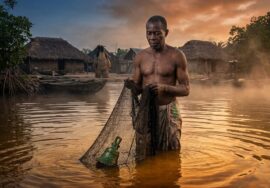
Ìpàdé still sits at the crossroads of three roads. The river still runs beside it, warm in certain seasons, cold in others, always moving. On clear mornings, when the light comes low across the water, they say you can sometimes see a figure standing at the bank — not quite in the water, not quite on land.
A bridge.
Belonging to both.
Ẹni tó bá fetí sí Ifá, kò ní sọnù lórí ọ̀nà. — He who listens to Ifa will not be lost on the road.