
The Net That Remembered: A Tale from the Efik People
In the time when the Cross River was still deciding the shape of its own banks — still negotiating with the mangrove roots about how far inland the water had permission to go — there was a fishing village called Ikang Ufok that sat at the place where the river widened its mouth and tasted, for the first time, the distant salt of the sea.

Ikang Ufok was not a large village. It was not a famous one. What it was, was old — old in the way that certain places are old, where the age is not measured in years but in the density of what has happened there, the accumulated weight of all the living and dying that has soaked into the soil until the soil itself has opinions.
The village had two things it was known for among the surrounding communities.
The first was its fishermen, who could read the Cross River the way a scholar reads a familiar text — quickly, with the confidence of someone who has read it many times before and knows where the important passages are hidden.
The second was its Ekpe lodge.
The Ekpe was not something you explained to outsiders. This is not evasion — it is accuracy. Some things do not survive translation. The Ekpe was the highest authority in Efik life, older than any chief currently living, older than the memory of the oldest elder. It was society and spirit simultaneously, law and mystery in the same body. When Ekpe spoke — when the great masquerade moved through the village in its raffia and its terrible beauty — the world reorganized itself around that movement. Men stepped back. Women went inside. Children who had not yet been taught to be afraid learned, in that moment, what fear that is also reverence feels like.
To be initiated into Ekpe was to be brought into the innermost conversation of the community. To be excluded from it was to live permanently on the outside of something that had no outside wall you could see or touch, only the constant awareness of its interior warmth, like standing in the cold near a house with lit windows that were not meant for you.
The fisherman at the center of this story was a man who lived in that particular cold.
His name was Asuquo.
I. The Man Without a Grade
Asuquo Edem was forty-three years old and had been fishing the Cross River since he was eight, when his father first placed a net in his hands and said: the river gives to those who learn its moods. Learn them before you learn anything else.
He had learned them. He knew where the river deepened without warning, where the current ran deceptively against its visible surface, where the perch gathered in the early morning and where they dispersed by midday. He knew the river’s seasonal personalities — its dry season restraint, its rainy season extravagance, the two weeks in November when it turned the color of dark tea and the fishing was inexplicably extraordinary.
He was, by every practical measure, a successful man. His canoe was well-kept. His nets were the finest in the village, repaired with the obsessive care of someone who understood that the quality of your tools is a form of prayer. His wife Mma Eka was a woman of quiet competence and considerable patience, and they had two daughters who were, in the opinion of everyone who knew them, better than their parents had any right to expect.
What Asuquo did not have was an Ekpe grade.
This was not an accident. It was a wound with a specific history.
Twelve years earlier, Asuquo had been preparing for initiation into the first grade of Ekpe — had saved for three years, had secured his sponsor, had done everything that was required of a man presenting himself to the society. And then his younger brother Effiong, reckless and charming in the way of men who have always been forgiven, had borrowed a significant sum from a senior Ekpe member and failed to repay it, and the debt had been placed — in the way that certain debts are placed in close communities, like stones on a scale — against the family name.
Asuquo had paid the debt. Every coin of it, over two years of painful economy. But the senior member — an old man named Ntoe Bassey who held grudges with the careful attention of a man tending a valuable garden — had decided that payment was not the same as restoration. The family name had been embarrassed in Ekpe business. Initiation could wait.
Ntoe Bassey had died four years ago. He had not, before dying, lifted the informal prohibition. And in the way of these things, the prohibition had calcified from one man’s grudge into community convention, and community convention is the hardest wall to dismantle because it has no single architect and therefore no single person with the authority to tear it down.
Asuquo fished. He maintained his nets. He watched the Ekpe masquerade pass his door and felt the cold that has no name for itself.
II. The Net
It began on a Tuesday morning in the long dry season, when the river was at its most transparent — the kind of clarity where you could see the bottom in the shallows and trick yourself into thinking you understood the depths because you could see the shallows so clearly.
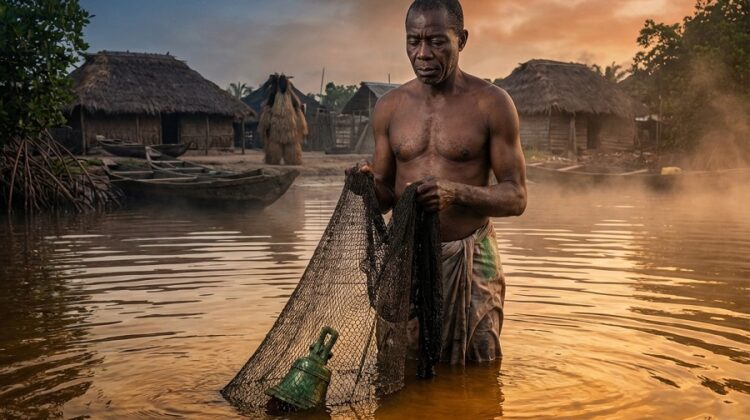
Asuquo had gone out before dawn, alone as he preferred, paddling to the deep channel where the serious fish lived. He cast his net three times and pulled in a modest but respectable catch. On the fourth cast, the net snagged.
This was not unusual. The river bottom had its own geography of obstacles — submerged branches, old anchor stones, the occasional debris of a community’s long habitation of a riverbank. He pulled at the net with the practiced patience of a man who has freed a thousand snagged nets and knows that patience is always more effective than force.
The net did not come free.
He pulled harder. The canoe tilted with the effort. The net held with a resistance that did not feel like wood or stone — it felt, in the way that the hands know things before the mind catches up, like something that was holding back deliberately.
And then, beneath the surface of the water, something moved.
Not a fish. Not a branch shifting in a current. Something that turned, slowly, with the deliberate quality of a thing that has been still for a very long time and is now choosing to move.
Asuquo’s hands went cold.
The net rose.
What came up with it was a mask.
It was Ekpe. He knew it the moment it broke the surface, knew it the way you know a thing that you have spent years circling from the outside — with the sharp, complicated recognition of something simultaneously forbidden and familiar. It was carved from a wood so dark it was nearly black, the grain of it running in patterns that looked, at certain angles, deliberate — as though the tree itself had been growing toward this shape. The features were not realistic in the way of portrait carving. They were distilled. The brow was heavy with authority. The eyes were not eyes exactly but the places where eyes would be if eyes were composed entirely of intention. Around the perimeter of the mask, intricate geometric patterns had been cut so precisely that they caught the early light and held it.
It was old. Not old like his father’s canoe or old like the village itself. Old like the river. Old like the specific gravity of a secret that has been kept long enough to become true.
His hands were shaking. He was a practical man who had made his peace with the supernatural the way people who live close to rivers make their peace with floods — by acknowledging their reality without romanticizing their danger. He knew what it meant to bring an Ekpe object up from the river uninvited. He knew there was no grammar in his world for what to do next.
He wrapped the mask in the cloth he kept in the canoe for exactly nothing — for no purpose he had ever anticipated — and paddled home in the growing light, and the river was very quiet around him in the way that things are quiet when they are paying close attention.
III. What the Mask Remembered
He should have gone immediately to the Ekpe lodge. He understood this. A found sacred object had a proper procedure — a path from finder to authority that existed precisely to prevent the chaos of an individual being alone with something that belonged to the collective.
He did not go to the lodge. He went home. He put the mask in the back room where he kept his net-mending tools, under a cloth, and he sat outside and stared at the river for a long time.
The reason he did not go to the lodge was a reason he could not have explained cleanly to anyone, including himself. It was not greed — he had no use for an Ekpe mask and no illusion that keeping it was possible. It was not fear exactly, though fear was present. It was something more complicated than either of those things. It was the feeling of a man who has spent twelve years on the outside of a door suddenly holding, in his own hands, something that came from the inside of that door. The feeling of a proximity that was also, because of everything it reminded him of, a kind of grief.
He kept it for three days.
On the first night, he dreamed of his father — not a comfortable dream, not the warm dream of a beloved dead person returned temporarily to reassure you. His father stood in the dream with the expression he wore when Asuquo had done something that disappointed him, and he said nothing, which was worse than if he had spoken.
On the second night, he dreamed of Effiong — his brother, now living in Calabar, now prosperous in a way that had never quite reconciled itself with what his carelessness had cost. In the dream Effiong was laughing, as he always laughed, with the full-bodied abandon of a man who had never learned to carry his debts in his body. Asuquo woke from that dream with an anger that surprised him with its freshness. Twelve years, and it was still that fresh.
On the third night, he did not dream at all. He simply woke at the deepest hour of the night to absolute silence and the certain knowledge, arriving without preamble, that the mask was awake in the back room.
Not awake like a person. Awake like a fire that has been burning quietly and has reached the point where it requires acknowledgment.
He got up. He went to the back room. He sat on the floor before the cloth-covered mask and in the dark he said, quietly, to whatever was listening:
“I know I should have taken you back already. I know what I was doing by keeping you. I was holding something that was never mine to hold, because holding it was the closest I have ever been to the inside of a thing I was kept from.” He paused. “I am not asking for anything. I just needed to say that out loud to something that might understand it.”
The silence that followed was not empty. It was the silence of something that had heard, and was deciding what hearing required of it.
In the morning, Asuquo wrapped the mask carefully and walked to the Ekpe lodge.
IV. The Lodge
The Iyamba — the head of the Ekpe lodge, a broad-shouldered man named Edet Okon who had held the position for nine years — received him in the outer room with the measured expression of a man who has learned to keep his reactions one step behind his understanding.
Asuquo placed the wrapped mask on the mat between them and told the complete truth. The net. The snagging. The three days. The dreams. The reason for the three days, which was the hardest part to say and which he said anyway, because he had spent the pre-dawn hours deciding that if this was the last conversation he had with the Ekpe lodge, it would at least be an honest one.
Edet Okon listened without interruption.
When Asuquo finished, the Iyamba was quiet for a long time. Then he reached forward and folded back the cloth.
He looked at the mask for the duration of many breaths. His expression shifted through several territories that Asuquo could not read, arriving finally at something that looked, unexpectedly, like recognition.
“This mask,” Edet said slowly, “has been missing for thirty-one years.”
Asuquo said nothing.
“It disappeared the night Ntoe Bassey was initiated into the highest grade. We assumed it had been stolen. We searched. We made inquiries. We performed rites for what we believed was a desecration.” He touched the edge of the mask with one finger, very lightly. “Ntoe Bassey always denied knowing anything about it.”
The name landed in the room between them.
Asuquo looked at his hands. “He was the one who kept my family from Ekpe.”
“Yes.” Edet Okon looked at him directly. “I know the history. I have known it. There are things in this lodge that were done incorrectly and that I inherited rather than chose.” He was quiet for a moment. “The river kept this for thirty-one years and gave it to you.”
“I don’t know what that means.”
“Neither do I, completely.” The Iyamba rewrapped the mask with a care that was itself a kind of speech. “But the river has its own record-keeping. It does not give things to people randomly. It gives things to the people who are owed something by the thing it is giving.”
V. The Haunting of an Honest Man
They initiated Asuquo into Ekpe three months later, in the proper season, with the proper ceremony. Edet Okon sponsored him personally, which was a statement the lodge understood without it needing to be explained.
It should have been the resolution. The wrong righted, the door opened, the cold replaced by the warmth of belonging. In the stories that tie themselves up correctly, this is where the man exhales and the music swells and the thing that was missing is found and placed where it belongs and everyone recognizes the rightness of it.
But Asuquo was a fisherman who knew the difference between the surface of the river and its depths. And what lived in the depths of this resolution was not peace.
It was the mask’s history. Ntoe Bassey’s hands on it thirty-one years ago. The thing it had witnessed before it went into the water — whatever act of concealment or corruption had sent it there. He had held it for three days and it had spoken to him in the grammar of dreams, and what it had said was not only about him. It was about the longer story. The story he was now inside of, that had been running beneath his life without his knowledge, that had shaped his father’s face in that first dream with an expression that was not only disappointment but something older than disappointment.
He continued fishing. He attended lodge meetings with the quiet faithfulness of a man who is genuinely grateful for what he has been given. He mended his nets with his customary obsessive care.
But on certain evenings, sitting outside after the day’s work, he would feel the weight of thirty-one years pressing against the present moment — all those years of men making decisions in the lodge that the lodge itself did not know were being made. All those years of a stolen mask in dark water, keeping its record. All those years of his family standing outside a door that had been closed by a dead man’s dishonesty.
He did not tell Mma Eka the full depth of it. She knew he had been initiated. She had wept with a relief so physical it had surprised them both. She knew the lodge had righted a wrong. She did not know about the specific weight of what the righting required him to carry — because knowing would worry her, and worrying her served nothing.
This is the thing about certain truths: they cannot be shared without becoming burdens distributed rather than burdens resolved. And so you carry them alone, the way the river carries things in its deepest channel — not visibly, not noisily, but with the permanent and patient momentum of something that has no choice but to keep moving.
VI. The Last Morning
He died in his sixty-first year, in the early morning, on the river.
Not dramatically. Not in a storm or a capsizing or any of the violent ways that the river sometimes claims its fishermen. He simply did not come home. When his sons-in-law went out to look for him, they found the canoe drifting in the deep channel with the net half-cast — as though he had been in the act of throwing it and had stopped mid-motion, mid-breath, and let go of everything at once.
The net was in the water. It was the finest net in the village, repaired so many times with such care that the repairs had become part of its original design — indistinguishable now from what it had first been, carrying the history of forty years of use in every knot.
They pulled the canoe in. They retrieved the net.
At the center of it, caught as cleanly as any fish, was a single brass Ekpe bell — the kind worn by senior members, old enough to be from another generation entirely, its surface greened with age and river water.
No one knew where it came from. No one could explain it. The bell bore markings that the oldest lodge members said they did not recognize, and the ones who were not certain they did not recognize them said nothing, because there are things that are better held in silence than dragged into the light where they might not survive the examination.
They buried Asuquo with his net folded beside him, as he had asked — not as a sentiment but as a practical matter, he said, the last time he spoke of it. Because a good net, he told his daughter, is not a possession. It is a relationship. And you do not end a relationship just because one of the parties is no longer in the same form.
The bell they returned to the river.
The river accepted it without comment, the way the river accepts everything — with the long patience of something that has been receiving the world’s unfinished business since before the world thought to name it.
In Ikang Ufok they still say: the river does not lose things. It keeps them until the right hands arrive.
They say it when a fisherman brings up something old and strange in his net. They say it when a wrong that has been underwater too long finally surfaces in the light.
They say it the way people say things that are true and also unbearable — quietly, and only in the presence of the river, where the words can be given somewhere to go.
Asuquo Edem was a fisherman who carried more than fish.
The river remembered him.
That is enough. That is, in this world, more than most.
Ke dia ke Efik — This is how the Efik people say it happened.